
What TRIZ is
TRIZ is Genrich Altshuller’s theory of inventive problem solving. The account below is the explanatory text from the old triz.org pages, with marketing lines left out and a few spelling errors corrected.
Origin
TRIZ is used across industries and sciences. Parts of it are taught to children and to adults. It was built from empirical material, especially patents, which record how inventive people solved inventive problems. That record became an analytical way to work on inventive problems, and then the basis of TRIZ.
A consequence of Altshuller’s theory, as the old page put it, is that inventiveness and creativity can be learned.
The old page argued that problem solving is a life skill in the same family as language and mathematics, and that schools do not teach it as a subject of its own. It described TRIZ as a process for the resourcefulness and imagination used in complex work, and it named creativity and innovation, critical thinking and problem solving, and communication and collaboration as the related skills.
Technical systems
The evolution of technical systems is governed by objective laws. When one part of a system has reached the top of its performance, further improvement conflicts with another part. Resolving that conflict improves the less developed part and moves the system toward an ideal state. The old page said this is why the evolution of a system can be forecast.
Everything that performs a function is a technical system. Cars, pens, books, and knives are examples. A system can contain subsystems. A car contains an engine, a steering mechanism, and brakes, and each of those is itself a technical system. The hierarchy runs from a system of two elements to systems with many interacting elements.
| Technical system | Subsystems |
|---|---|
| Transportation | Roads, drivers, maps, cars |
| Car | Power train, brakes, heating, steering |
| Brakes | Brake pedal, hydraulic cylinders, fluid, brake pad assembly |
| Brake pad assembly | Pad, mounting plate, rivets |
| Brake pad | Particles, chemical bond |
In TRIZ the simplest technical system is two elements with energy passing from one to the other. Chalk and a blackboard are not a technical system until force passes through the chalk and it meets the board. Chalk is also its own system: a molecular structure whose bonds produce the material. Improving that bond means analyzing the molecular system. At the same time, chalk is a subsystem of the chalkboard. A change in a subsystem can change the systems above it. When solving a problem, the old page said to look at the systems above and below the one in hand. Technical systems also emerge, mature, and are replaced.
TODO. The molecular rows of the old table were garbled in the text extract (the same cell text repeated). They are not reprinted here. Confirm the table against a clean copy if it should be restored in full.
Levels of innovation
Altshuller’s study of patents separated inventions by inventive value. The old page stated five levels.
- A simple improvement of a technical system, using knowledge from the industry that system already belongs to.
- Resolution of a technical contradiction, using knowledge from different areas inside that industry.
- Resolution of a physical contradiction, using knowledge from other industries. Levels 2 and 3 solve contradictions and are innovative by that definition.
- Development of a new technology, using breakthrough solutions that require knowledge from different fields of science. This level improves a function by replacing the original technology, for example replacing a mechanical system with a chemical one, rather than by solving an existing technical contradiction.
- Discovery of a new phenomenon that pushes an existing technology further.
The old page said Altshuller concluded that 77% of patents belong only to levels 1 and 2, and that using TRIZ can raise solutions toward levels 3 and 4.
Ideality
The goal of a technical system is to provide a function. Conventional engineering, as the old page contrasted it, says a function requires a new mechanism. TRIZ asks for the function without adding a mechanism.
The law of ideality says that a technical system, over its life, tends to become more reliable, simple, and effective. Each improvement moves it closer to ideality: less cost, less space, less wasted energy. Ideality is the fullest use of resources that already exist, inside or outside the system. The more freely available those resources are, the more ideal the system. An inventive result can be judged by how close it is to that state. When a system reaches ideality, the mechanism disappears and the function is still performed.
Example from the old page. A meat plant in South America ships product to the United States and had installed refrigeration in cargo planes to keep the meat frozen. To carry more product, the owner replaced the weight of the refrigeration system with meat. At 15,000 to 25,000 feet the air is below 32°F, so the refrigeration system was not needed. The page’s conclusion: using a resource that cost nothing moved the system closer to ideality.
The same page named other moves toward ideality: give the system more functions (an entertainment center with a radio, tape player, CD player, and amplifier); move functions onto the element that does the final action (a crimping tool that also cuts wire, strips insulation, and crimps the terminal); move functions to a supersystem or the environment (greenhouse windows that open and close by a temperature-sensitive bimetallic spiral); and use resources already present (the page cited Comtrad Industries of Virginia and its Spectrum Antenna, which used a house’s existing wiring to improve reception).
Contradictions
The old page said the strongest solutions come when an inventor solves a problem that contains a contradiction. A contradiction appears when improving one parameter of a technical system makes another parameter worse. Weight, size, color, speed, and rigidity are examples of those parameters. A compromise is the usual next step, and it leaves the contradiction in place.
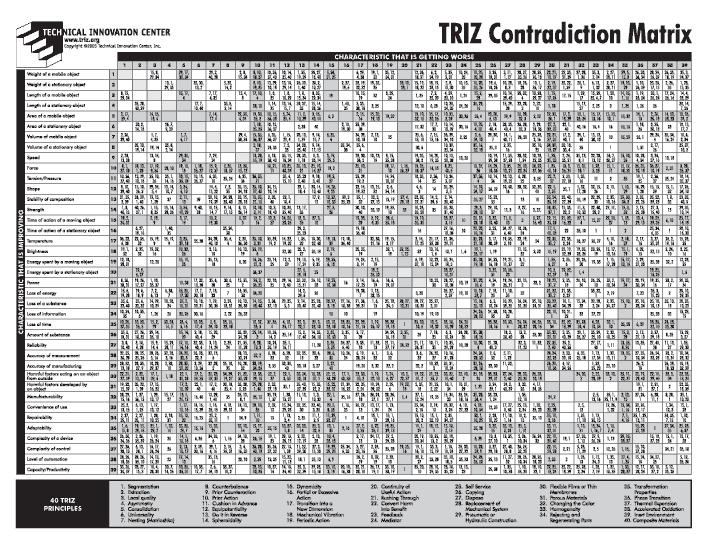
Increasing the power of an engine increases its size. Installing a more powerful engine so an airplane can fly faster increases weight, the wings may not support takeoff, and larger wings add drag that slows the airplane. The page called these technical contradictions and said the 40 principles are used to resolve them.
A physical contradiction asks one element, or the whole system, to have two opposite properties. The page named separation in time, separation in space, a change of physical state, and separation upon condition.
Landing gear must be present to land and take off, and absent in flight because it adds drag. The contradiction is resolved in time: the gear retracts. For high diving, water must be hard enough to support the diver and soft enough not to injure them. The page’s resolution in space was to saturate the water with air bubbles, so the pool contains both air and water.
Lines of evolution
The old page said Altshuller established eight patterns, or lines, of technical system evolution:
- Life cycle
- Dynamization
- Multiplication (transition to a bi-system or poly-system)
- Transition from macro to micro level
- Synchronization
- Scaling up or down
- Uneven development of parts
- Replacement of the human (automation)
The page explained three of them.
Dynamization
A system moves from a rigid structure toward a flexible one: one joint, then many joints, then a fully flexible system. A rigid system may also be divided into elements that move relative to each other. Examples on the page: a car steering column with a joint for vertical adjustment; a collapsible antenna; retracting landing gear; a screwdriver stem of two springs wound in opposite directions, one inside the other.
Multiplication
A system starts as one system and later multiplies. Similar elements added together form a homogeneous system with a new property. Two boats on one frame, a catamaran, are more stable than two separate boats. Different elements form a heterogeneous system with more functions in less space. A pocketknife starts as one blade, then gains other blades, scissors, a screwdriver, and a file. An opposite function can be added: a pencil joined to an eraser, a tape recorder that records and erases. The page said multiplication usually ends by rejecting the extra elements and returning to a mono-system, which starts the cycle again.
Transition to the micro level
Elements tend to shrink until they reach molecules and atoms. A record player moves from a needle in a groove to a laser reading a digital disk. A computer mouse moves from a ball that turns hand motion into an electrical signal to a touch plate that turns the motion of a finger into a signal.
TODO. The old page did not explain life cycle, synchronization, scaling, uneven development, or automation beyond naming them. Do not fill those from memory. Supply the missing paragraphs if a clean source is available.
40 principles
The old page called the 40 principles generic suggestions for an action in a technical system. Altshuller found them by studying and grouping thousands of patents. They are used alone or together on technical contradictions. The page said a full description of each principle is in the book 40 Principles: Extended Edition, and that implementing a chosen concept remains the engineer’s work.
Principle 1, segmentation, separates one element into many small connected elements. The page’s example: to keep a nail from causing a flat tire, divide the inner space of the tire into many sections.
Principle 10, periodic action, replaces a continuous action with a periodic or pulsating one. A continuous stream of water on a lawn can damage soil and run off. A pulsating sprinkler avoids that.
TODO. The old page also listed short definitions for the rest of the 40. They are not reprinted here, both because the extract was cut off and because those definitions track the book. Confirm with Richard whether the full list should be republished, and from which edition.
Standards
The old page gave standards two jobs: to improve an existing system or synthesize a new one, and to draw a problem as a substance-field (Su-Field) model. In the operating zone the model has two substances and a field. Reading the model shows what has to change.
Example. A factory makes a new steel. Additives are stirred into the molten steel. The mixer blades need a coating so they do not melt, but the coating may pollute the melt. In the page’s model, S1 is the blade, S2 is the molten steel, and F2 is the heat that melts the blade. A third substance, S3, is introduced as a modification of S2. Cold, F3, applied to the blade grows a crust of the molten material on the blade and protects it.
The page said Altshuller offered 76 standards in five classes:
- Build or destroy an S-field.
- Develop an S-field.
- Transition from the base system to a supersystem or to the micro level.
- Measure or detect anything in a technical system.
- How to introduce substances or fields into the technical system.
ARIZ
ARIZ is the central analytical tool of TRIZ. It is a sequence for hard problems. The first version was developed in 1968 and revised over the next 20 years. The version the old page called the most used, ARIZ-85C, was published in 1985 and has nine steps. Each step has many sub-steps. The page gave this outline.
- Analysis of the problem. Move from a vague statement to a mini-problem without industry jargon: a system of elements A, B, and C has a technical contradiction, and the required function must be provided with minimal change. The system should stay the same or become simpler. Choose which contradiction to resolve, then formulate a model of the problem.
- Analysis of the model. Draw a simplified diagram of the conflict in the operating zone, a narrow area of the conflict, and assess the available resources.
- Ideal final result. The statement usually reveals opposite requirements on the critical component. That is the physical contradiction. A vague problem has become a specific physical problem. The page said many problems are solved by the end of this step, in which case you go on to steps 7, 8, and 9.
- Outside substances and field resources. If the problem is still unclear, the page said to apply the “small miniature man” model to understand it.
- Informational data bank. Try the standards together with a database of physical effects.
- Change or reformulate the problem. If it is still unsolved, return to the start and reformulate it in the supersystem. The loop can be repeated.
- Analysis of the method that removed the physical contradiction. Check whether the contradiction was removed in the most ideal way.
- Use of the solution. Look at effects on adjacent systems, and look for other problems the solution could serve.
- Analysis of the steps that led to the solution. Compare the path actually used with the path ARIZ suggests, and keep useful deviations.
The page closed by saying that learning the tools takes many hours and many practice problems.